Showing posts with label Towns and Cities. Show all posts

Tuesday, October 16, 2018

A Presiding Commander of Ellsworth Post

   I hope all you 'guys' are doing fine. I haven't so much been taking any kind of a 'sabbatical' from the blog. Simply, my efforts and services are often required elsewhere. I'm getting along alright, thank you. Yet, between willpower, actual plans, and real time devotion to the blog have seen a small tug of war when it comes to the 'nitty gritty' of creating fresh quality articles in a timely manner. Don't worry, "Fayette/Westmoreland Forgotten History" as a blog, still exists. Thanks for your continuing patronage!

  
 Prologue and Description 

   Now, as a small foreword, it might be best if this blog is not overly long, because I would not want to bog people down too much with a lot of details on this subject too many more times. Keeping that perspective in mind might add to the interest of this type of material, yet this does border on a unique episode of military history, folks so it is well padded with historical data regardless.

     The truth is, this idea was planned as another addition to the Relatives and Ancestors series. On second thought, the decision was made for the material to go beyond basic family genealogy with a deeper meaning of a revealing historical context than just about my relatives.

   While poking around the internet a while back, I came across some fascinating information on a Presiding Officer for Colonel Ellsworth Post of the Civil War. "The Proceedings of the Annual Encampment of The Grand Army of the Republic" in various numbered volumes was a major source of information. Now, you can probably imagine that I hardly expected to locate something personal of such a caliber in this manner. Only a sense of curiosity and a touch of presentiment caused me to search it out. Just an idea, really. I became thoroughly delighted to of made such a surprise discovery, however piecemeal it was at first glance.

    These Reunions were held at, and behind the old Steiner roller rink which was a park which land was bought up for that specific purpose in the late 1880's. Indeed, it was used for other purposes: company picnics and various clubs, just to name a few,

    Colonel Elmer Ellsworth

                                                 
Colonel Ellsworth, courtesy of the Scottdale Historical Society

      Ephraim Elmer Ellsworth was a popular figure. He was a colonel of the Chicago National Guard Cadets and worked with the New York City firemen. He studied law under Lincoln in Springfield, Illinois, and helped organize his 1860 presidential bid. The colonel also became a competent officer, and close friend of Abraham Lincoln. 

       The story goes that while looking out the window at the White house near the beginning of the Civil War between the American states, the President sternly noted to Ellsworth the 'Stars and Bars' flag freely flying across the Potomac River. On the morning of May 24, 1861, under the direction of General Scott, after disembarking from one of the steamers, Ellsworth, the founder of the 11th New York Infantry Regiment, with little resistance from a retreating force, headed up into the Marshall House hotel in Alexandria, in the Commonwealth of old Virginia, which became an independent city. With a few of his men, he proceeded boldly upstairs, grabbing the offending Confederate flag from the roof top and began rolling it up. On returning downstairs he was suddenly confronted by the secessionist landlord, James Jackson, who claimed he was 'a boarder.' Jackson quickly let the colonel have it with the roar of a shotgun in the chest. Abruptly, on this encounter, Jackson was immediately shot dead.

       As can be imagined, Abraham Lincoln was saddened and almost inconsolable. Colonel Ellsworth had the distinction of being the first casualty of the Civil War. Lincoln had the favorite officer laid out properly in the East Room for the funeral.

      "Remember Ellsworth!" was soon a Union rallying cry! Various places, towns and military posts were named after him in his honor. This was indeed the case with a special one in Scottdale, East Huntington township of Westmoreland County, Pennsylvania.


 Ellsworth Park

     A Sept. 7, 1887 article in the Daily Courier maybe allows the best gist of what the early encampments were like to actually experience. The writer relates that The Grand Army posts of Dunbar, Uniontown, Dawson, Stonerville (or Alverton), Springfield,  Connellsville and Greensburg were their in full regalia; in all, 1,000 of these men showed up at the Scottdale post starting on Thursday evening, culminating where "Old Veterans Play Soldier." This was , of course, aat Camp Ellsworth, Post 209, or, as specifically  termed, 'Ellsworth Park' in Brown's Grove, (later called, Browntown by the locals), just north of the main thoroughfares of Scottdale. The Scottdale historical Society may be interedted in this story. I haven't gotten around to informing them or learning of thier opinion on these matter so far.


       They would tend to kick things off with a parade from the 'handsomely decorated' town with 'a large and enthusiastic crowd' to the site that at one time was over 8 acres, where the Everson Drum Corp was in attendance playing 'old time martial music'.  There was set up a little village of tents in the woodland and everything was arranged for field duty in as realistic a manner as possible. Next up, all were regaled by lots of song and speakers, They probably then built up the bonfires, though it doesn't come right out and say so. On Friday afternoon, a 'sham battle' was displayed for the 'entertainment' of everyone present. No one was hurt, but the powder burnt 'was fearful to contemplate'.

     This was followed at the gathering by a rousing address from a United Presbyterian minister of Scottdale at precisely 8 p. m. By Saturday, there was estimated to be 10,000 visitors, many of them old vets arriving by train from Mount Pleasant, Latrobe and Irwin to witness the great spectacle and, one would suppose, take refreshments. At noon dinner was served, this must have been a lot of industrious work for the ladies involved in cooking and the clean up would surely of been something else - there were more speakers, colonels and generals and parades by various regimental companies. Then, another reenactment took place. Sunday saw more grand dress parades and religious services watched and admired by the many civilians crowding the camp grounds. Thus following, another sham battle between the infantry, cavalry and the artillery; not without a few wound that were only all too real. These events must certainly of been a wondrous sight, eh folks? Here, here. They finally broke camp late Tuesday night to end the festivities and their fellow citizens heartily enjoyed the whole endeavor and were thanked for their hospitality one would assume with civil decorum while the reception of the vets were highly appreciated as well.


Overhead view of Ellsworth Park from the 1930's.


Annual Encampments

    Enter: My great, great grandfather. I already knew part of his unique story and sever wounding in the Civil War and his service at Gettysburg. Now there was more to learn and more to tell.

   The first of these Annual Encampments began in 1888. Of course, my main point remains with James Wilson's connection to the G A R, but no attempt is being made to necessarily ignore other aspects of the gatherings or those other worthy high officials involved except to not let the size of my post expand greatly beyond original intentions.

     I had more material taken from older research I am looking around for indicating the old veteran's overriding presence on years between 1905 and 1910. Still, as an actual example, James Martin Wilson of Wooddale, Fayette County, was indeed Ellsworth Post Commander in 1913 for Scottdale No. 209 and for the Sons of Veterans, according to The Daily Courier, Wednesday, May 21, of that year and in other years too.

    Below is a record of the Annual Encampment from the year 1914 with James Martin Wilson as the Post Commander for Col. Ellsworth Post 209 Grand Army of the Republic for that year located in the middle:


       The exact manner in which my, g, great grandfather came to this high position, I know not. His personal story, of a serious wound through the throat that he wasn't at first aware of through the effects of shock, into which was run a handkerchief to keep out the maggots that would infect the wound, is true and one of the rare family traditions we have of him. This is certainly a grisly one which may of had a grip on others with the added gift of storytelling. Otherwise, not much else is sure at this late date. But, he must of had the presence, influence and some charm to be awarded such an honor in those times. This was a very serious event and an important experience to represent the 'Grand Army' the way he did. I am proud to note, he also headed up the Memorial Services for Decoration Day at the Mount Olive United Brethren Church of which he was an early member, as was his son, Shed and grandson, Meryl Wilson. He held the illustrious title of Post Commander for at least four years in the early years of the twentieth century as well: those years with documentation are 1912-1915. I believe I've ran across one or two other earlier years as well. It is unfortunate locating again a portion of the exact proof was one big reason this blog post was so long in seeing the light of day. I trust enough evidence is scattered around in here to reasonably allow for the case to be well made.

                                                   
Comrade James Wilson


    The duties of this particular leadership role were fairly impressive: keeping an eye on entertainment, helping with guests, coordinating events, while having superior charge of the whole encampment under their supervision and were engaged with most activities and personally involved the direction of the various concerns of the GAR eight-acre grove while making impressive, moving speeches. This was not something given out lightly to the military or to the public at large!

     At one time, and I'm not positive how often, the surrounding posts, such as Dunbar, Dawson, Springfield, and even Connellsville also sometimes also encamped here, at least for a weekend in certain years. The important festivities would begin at 7:30 p. m. on Thursday evening. These often took place in late August and early September, but not always. I haven't followed the earlier years in too much depth.

    James Wilson also traveled around occasionally for the National Encampments. One example could suffice. For the annual Convention of the Department of Kansas, Womens Relief Corps, he attended as Secretary representing Ellsworth Post:


 In creating an article in honor of my great, great grandfather, James Martin Wilson,  I personally know very little about him. It may be supposed the man has the appearance of a basically unassuming person of average proportions, yet there was more to him than that. Naturally, I am very proud to have access to what is available and of his particular commitment and serious dedication in the Civil War and beyond. The different reenactments in Westmoreland and Fayette counties here in southwestern PA must have been quite exciting events for the old timers and the observers as well. He saw action at the battlefields in numerous sites which include Gettysburg.


    James had the distinction of being a one time Constable of Bullskin Township of Fayette County, Pa., in the year, 1873 which I will get back to in a moment or two. One more thing, clicking the 'relatives' or 'Wilson' links on the sidebar of the blog will provide further information for the subject if visitors will just scroll down.

    We do know that this ancestor use to hold family reunions at various place, at least one being at the Mount Vernon Park. He was married to Louise Grimm, (my g, great grandmother, of course), and rather conveniently, her family lived right across from him on the Shenandoah Road near the corner of Breakneck. The James Wilson farm was on the side where Woods' greenhouse recently was in business. I wish I could add an old photo of the old homestead, but if such exists, my side of the family have no knowledge of it. I heard there was once a photo of James Wilson in his Union uniform. We haven't had the proof to substantiate this tradition as of yet.

     From what info I could gather, and some of that is speculative to the extent it has not been completely confirmed, the situation of ancestry appears that James (2) was the son of James Wilson (1) and Elizabeth McBrady. Now, that James' parents were William and Catherine Wilson. He, himself, was born in 1819, in Hornellsville, Pa and got married and later died in Fayette County, in 1903. I recently discovered some likelihood these Wilson's were related to those of Dunbar. Continuing in this vein, it appears that the earlier James' immediate children, and therefore my g, great grandpap's siblings, would have been born in this order : Anna, Alexander, Martin, Joseph, Daniel, William, James, who lived in Connellsville, (which fits in with my g, g, grandfather), Charles, and Minnie, who died in infancy.

     James was even known to host the occasional picnic st his residence for the Grand Army veterans as can be observed below from a newspaper article for July 30, 1907:


     If that wasn't enough, there is more about James Wilson as Post Commander for the year 1913 at Ellsworth Post in another article, while here is this particular reference for a memorial churchservice for that year:

    I just discovered an old note that proved James was also the Post Commander of Ellsworth Post for 1912. If I find time I will try to upload this and possibly others. However, hopefully, you all get the idea behind this part of his life.

 More Historical Information:


   In 1873, about a decade after his services and traumatic experienced of the Civil War, James M. Wilson was elected a Constable of Bullskin Township. The exact job description...


    As can be noted by this page from an old history book, John Miner appears to of been the Justice of the Peace during James Wilson's constabulary watch. Justice Miner became  an ancestor of future generations of the Wilson family by the occurrence of his daughter marrying George Hatfield. George was the grandfather of a lady whom James Wilson's son, Shed Wilson, had married, one Mary Miner Wilson. John Miner Jr, was one of the more prominent men of his community, but maybe more information should be related in a proper post. Although, I find that certain details have remained a bit sketchy, there really are many extra details involved, and some of these are not posted on previous Relatives and Ancestor posts of past 'Fayette/Westmoreland Forgotten History' articles for the simple reason that they were not known then.

     If the subject of the military posts interests you a lot, included in 'Snowy Stroll Through Scottdale', is some added material on Ellsworth Post.

    There is a statue to Colonel Ellsworth in Mechanicville from the unveiling of May, 1874. There is none to James Martin Wilson. None, except those we make of in our hearts - a living monument. As written on the colonel's gilded granite, a note he wrote just previously to his dear mother:

      "I am content, confident that he who noteth even the fall of a sparrow, will have some purpose even in the fate of one like me"
                   

Wednesday, September 6, 2017

Gallavanting In Greensburg

   Welcome back to F/WFH for another installment. In the post below we will be concerning ourselves with the basic structure of the history of Greensburg, located in Westmoreland County in the Laurel Highlands of southwestern Pennsylvania.

   A county seat of this magnitude holds so much voluminous and detailed historical matter in so many areas: sports, architecture, government, churches, activities, stores, cemeteries, schools, and many noted figures, such as distinctive and important industrialists, the form of a condensed outline has been chosen as most convenient while hopefully managing to provide a basic assessment of a special place that has been neglected to this point.


     Newtown and Jacktown

  The origins of this city began not long after the destruction of the original county seat, Hannastown, the first west of the Allegheny Mountains established in 1773 by Robert Hanna. Such concerned the site of the famous Hanna's Town Resolves of 1775 in many ways mirroring the soon to arrive,  Declaration of Independence to defend their God given rights against the oppression of the British. The event of the unfortunate loss of the town was accomplished in 1782 by Guyasuta and the Seneca Indians along with the French Canadians. After much bickering between other regions as well, by 1785 "Newtown" became the new county seat. The next year saw the building of the original Westmoreland County Courthouse in what is the heart of the Greensburg Downtown Historic District.

    The decision-making process of those times took much foresight and care in choosing the exact whereabouts of a new county capital; indeed, exposure to the elements, dangerous or hostile situations or indigenous tribes,  river commerce, quality of woodland and soil, popularity or lack of by citizens of the surrounding community, the keen ideas of investors, prior settlements, even scenery, and many more issues need be addressed and soon resolved; ideally, in the favor of the majority. The nearness of Fort Ligonier as well as the Forbes Road and Glades Path would surely be an example of two major factors in leaning hard toward this favored spot. The fact that by 1786 there were four taverns with capabilities of good provisioning and the comfort of an inn or two, certainly helped, though there were other factors in choosing this county seat as well: mainly that newly appointed commissioners, Benjamin Davis, Hugh Martin and Michael Rugh lived on or very near to the Forbes Road having a personal interest leading to the decision.

    By the year 1799, Jedidiah Morse in the American Gazeteer, described the city thus: "Greensburg, a post town and the capital of Westmoreland County, Pennsylvania. It is a neat, pretty town situate on a branch of Sewickly Creek which empties into Youghiagany River. Here are one hundred dwelling houses, a German Calvanist Church, a brick Court House and stone jail." In the days of wagons, moving families, stage coaches, and soon - to - come toll houses, you needed an insular place of worship for the faithful and it was a must in being able to lock up the thieves and rowdies.

  From the humble beginnings near the ending of the Revolutionary War of an inn built near an old wagon trail; this old road later became known as Penn Avenue. Early in its long history, Christopher Truby was the main founder of ol' Newtown, named after the count seat of his former home he emigrated from by 1772, Bucks County. In the early 1800's this was known as the Greensburg or Pittsburg Pike, a toll road completed in 1818. It slowly took on prominence after much debate and was accepted as the new county seat. This proud city was named after Major General Nathaniel Greene of the Continental Army in the Revolutionary War. The old jail was the corner of Pittsburgh Street and Pennsylvania Avenue. Most of the area north of Pittsburgh Street and west of Penn., Avenue were owned by Ludwig Otterman. Dutch Town was the section from West Pittsburgh Street to Vannear Avenue and Irish Town was further on the eastern hill of Pittsburgh Street.

 A sad reality concerns the sidewalk of the future courthouse site containing the market house which was also used as an auction block for the sale of slaves. This was finally dismantled by 1854.

 One of the busiest of the toll gates in Greensburg was on top of Chestnut Ridge between the city and Stoyestown at least from the 1820's through the 1830's with over 38,000 horses bustling through in the first year alone .


  Insurrection

  There were many areas of southwestern Pennsylvania deeply involved in the Whiskey Rebellion, including Pittsburgh, yet here were many distillers in many parts of the city of Greensburg, possibly the most toward Hempfield Township, which issues of this sort surrounded and inflamed. . That being the case, it is interesting to read that in a September Term of Court for 1795 various persons were tried on an indictment for a riot committed the year before, "in besitting the doors and windows and of the house of Simon Drum  in the town of Greensburgh, throwing stones etc. at the doors and windows with intent to beat, wound, tar and feather and evilly entreat Jaspar Yeates and William Bradford, Comissioners on the part of the United States, and Thomas McKean and William Irwin, Commissioners on the part of the State of Pennsylvania, to confer with thew citizens west of the mountains." According to the PA Archives, most were convicted, but first were deposited in the gaol and later 'exhibited' to the town, being marched through the town in the thick mud. These guys were later pardoned by Governor Mifflin. Maybe the shame of slogging around the streets continually was thought enough punishment.

  The militia leader and one of the major founders of the city, William Jack, had written to the governor that many of the people were adverse to the duty on spirits and basically proceeded to blame the Germans to an extent that they were extremely unwilling in the process and this appeared because they were ignorant of the language.


The Westmoreland County Courthouse on Main Street.

                                             
    The Westmoreland County Courthouse sits on Main Street, approaching near the top of the hill. It stands 175 feet and is the fourth courthouse, built in 1906 and designed by architect, William S. Kaufman, who was, coincidentally, born to Pennsylvania native parents. The oldest courthouse was, first, a log structure built from 1786 or 1787, depends on what is your source material, and the next was demolished in 1854, followed by the third, demolished in 1901.

   
   What may surprise many, in those much freer times, advertisements were made in the local papers to gather at the courthouse of the early 1800's to partake in meetings of various 'divine services' and preachers let loose with the sermons and preaching of reverends such as, James Estep, William M'Kindrey and Curtis Clay. So much for the modern notion of the separation of church and state!


                           General Nathanael Greene

                                            
Nathanael Greene, by C. W. Peale

    Born in Potowomut, Phode Island, where he became a statesman in the early 1770's and a member of the Kentish Guards, Nathanael Greene, (July 27, 1742-June 19, 1786), the illustrious  and prominent Revolutionary hero the General Greene Hotel was once named after near the turn of the last century, was the man Greensburg, Pennsylvania,  as well as Greene County, is so aptly settled on for its moniker. He was descended from Quaker Immigrants ho left Salisbury, England in 1635 for the New World. On arriving in Boston  by May of 1775, he was quickly made a Brigadier-General by June. He soon transformed from an initial defeat and loss through inexperience of Fort Washington on the banks of the Hudson to an endearing force lasting for eight years of service. In spite of the disrespect from Congress of his humble beginnings, his fame was abiding, service broad, and his loyalty deep. Greene reportedly died of sunstroke when his life was cut short at his Georgia home of Mulberry Grove, north of Savannah, though there may of been other complications from ailments such as asthma.

    As Alexander Hamilton stated it best at a Fourth of July, 1789 Eulogium on the death of the Major- General of the Continental Army, "To commemorate the talents, virtues, and exploits of great and good men... We seem to appropriate to ourselves the good they have done, to take a personal interest in the glory they have acquired, and to share in the very praise we bestow." He goes on to recall his exertions at Trenton, Princeton, Brandywine, Monmouth, Springfield, and tough battles as at Guilford Courthouse, Greensboro, North Carolina the import of his last command in the south; he goes on to demonstrate "that he was an accomplished master in the science of military command." With Morgan's genuine experience and tactics, while describing some of the more minor players, which, though Hamilton doesn't dwell on it for long, included the brave provisional militias of Marion, Sumter and Pickens and the factors of their enduring harassment of British troops in South Carolina, Hamilton gives worthy tribute to the deliverance of Greene's overall actions in Cornwallis's retreat to Charleston and on to Yorktown. By the way, some of this information and other details about the county seat of Westmoreland County has been related on the post "Origins of the Counties of southwestern PA.

    General Cornwallis once made the claim that,

   "Greene is more dangerous than Washington. I never feel secure when encamped in his neighborhood."

       
Old photo of Greensburg. The year is uncertain.


Into The Modern Era

    Like many of the cities,  towns and hamlets of the surrounding region, for various economic reasons, particularly the final closing of Greengate Mall in 2001, which was begun with so many quality stores in 1965, (not so in recent times), with the loss of Horne's and then Montgomery Ward. Soon we had the opening of the Westmoreland Mall in 1977 to help forget! But, if you are a near native of the region and old enough, like myself, you probably hold a few fond memories of visiting The Bon Ton, Waldenbooks, G.C. Murphy's, Spencer Gifts, Sweet Williams and RadioShack, among others, or just roaming the aisles with my brothers in the 1970's; this was THE cool place to go and to be seen! Some of these stores still exist in other neighborhoods or in other forms, under different names.


    Seton Hill College was a women's college. It was founded in 1885 by the Sisters of Charity. Now known as Seton HIll University, it has been coed since 2002, being closely involved in mobile information technology, health and the natural sciences and visual and performing arts. It provides a dynamic campus atmosphere. The University of Pitt-Greensburg is a state related regional institution first established in 1963 and was voted the "Best University in the Region" eight straight years. The Bobcats are the athletic teams and they also engage the Ben Franklin Society. Originally located across from St. Clair Park, it is now two miles to the south in Hempfield Township and with 22 buildings on a space of 219 acres the university can indeed boast of much academic achievement. By the way, there are many schools and cultural landmarks which I won't be going into here.

     Don't let the above statement bother you much - the athletic and sports history of the city and nearby environs would deserve a post of their own. Even the healthcare industry is to be highly enumerated. No, I'm not going to get started on all that, sorry.


      Arthur St. Clair

                                                    
Arthur St. Clair Monument

    Now we are taking a brief step back to the old days for a paragraph or so as I feel something needs to be related about St. Clair Park. Early on, it was moved to its present location toward the east, yet holds the statue and tomb of a notable figure in Arthur St. Clair. This Revolutionary General, a true patriot of the State of Pennsylvanian with much service and accumulated merit that later became a local here, was covered with much other material over three years gone by in a 2014 post providing a more in depth biography of this sometime hero, sometimes crticized man.

    While St. Clair's various war efforts in serving his country should of brought with him a certain celebrity he lived in nearby Youngwood under the sad distress of many difficulties while retiring in the County of Westmoreland.  He accumulating large debts and had to sell much of his property,  ending up as a tavern keeper.


     The city has surely taken renewed pride in the fact that a unique statue of Nathanael Greene by Chris Fagan was unveiled in the year 2000. He sstands, symbolically, all in bronze, in the depths of  St. Clair Park.


     The city is made up of eight wards, one of which, 'Bunker Hill' was actually named for the rowdy, wild fights at the Bushfields Tavern of the mid- nineteenth century, said to remind the surrounding folks of the Battle of Bunker Hill. Yep, so they say.

    Back in 1905, three neighborhood boroughs were absorbed into the county seat. These were: Ludwick, of East Greensburg, Paradise, of Southeast Greensburg, and Kinderhook to the north which includes the neighborhoods of Academy Hill, Country Club Meadows, Evergreen Hill, Saybrook Village, etc.

    Greensburg Station, back behind the courthouse, once served heavily by the Pennsylvania Railroad when opened in 1912, while PennDot's last servicing pretty much came to an end by late 2005, and it is now only the Amtrak 'Pennsylvanian' rail station as the old choo-choos are gone but not forgotten. The portico and structure retains a classy Flemish bond pattern topped by an ornamental clock tower and overall it is of the quaint Jacobean Revival style.

                                     
The old Greensburg Station


     What was once the West Penn Railways trolley headquarters, now houses City Hall. Despite visits by famous Democrats running for office for many a year, this was the original site of of the first National Republican Party Convention in 1854.

   Yes, Greensburg has seen it's share of depression in the last quarter century or so. In spite of this reality,  the city has found a way to thrive in major tourism, culture and business. There are many memories, as well. It is seventh in Pennsylvania in daytime growth and 16th for the same category in the United States.

     The Downtown Historic District consisted of many notable buildings from 1872-1930. The District was home to a significant commercial center as well as an important station of the Pennsylvania Railroad first initiating service here in 1852, and the headquarters of the now long gone West Penn Railways trolley system, now City Hall. Before the days of automobiles, the street cars served many smaller communities to the south and east. The Greensburg Railway Station on Harrison Avenue, (named for our ninth President, William Henry Harrison), had its one-story structure by 1860, then a large, impressive building developed by architect William Holmes Cookman, which was opened in 1912 to some fanfare. It is of the Jacobean Revival style and topped with a fairly unique clock tower. Made of red brick of Flemish Bond pattern, it served different purposes and an Amtrak Station in later years, finally taken up as a restaurant.

    Another important area is the Academy Hill Historic District lying between North Main and North maple Avenue and consisting of 63 acres. Some of its main attractions would be the Huff Mansion at 424 North Main St., a Georgian revival building built in 1900 now hoe to the YWCA, the unique shape of the Clawson House on North Maple, the Aquinas Academy, an elementary school, and an aged 1840 structure at 333 Walnut Avenue.

   Penn Avenue is the main route from the west to downtown Pittsburgh and the Gateway Center and Point State Park, also the oldest street in Pitssburgh. This was, in part, a meaningful ingredient in its eventual and continued success.

   Among the many department stores once regularly visited by eager customers to Main Street like,  J. C. Penny's and Sears, the one I recall the most was Troutman's in company with my mom and grandmother, riding the escalators from one department to another.

     The Westmoreland County Historical Society with its useful Calvin E. Pollins Memorial Library (free of charge)  and the Edward H. Hahn Archives is located at 362 Sandhill Rd. Suite 1, Greensburg, 15601, are a dedicated group. Hours are, Tuesday - Friday, 9-5 p. m. They can be contacted by mail concerning research. The Society contains much information and their resources should be quite helpful.


Drops of rain on Main Street in a recent trip to Greensburg


  South Greensburg 

   The Borough of South Greensburg was once known as Rughstown, settled on a farm by Michael Rugh in 1780. The 229 acres was later inherited by his grandson, Peter Rugh. The Rugh House, said to be the oldest extant building within Greensburg, replaced an older building and sits at 1213 Broad Street. In 1881, on land acquired earlier from the Rughs, George Huff sold the property to the Greensburg Coal and Coke Company which also had a mine and brickwaork. Later, this went by the name of the Keystone Coal and Coke Co. By the late 1880's there were many houses built in which the locality became known as Huff, or Huffstown.

    A location in South Greensburg down the slope of the hill was once known as the 'Bullet Field', because tradition claimed it was the area used by the locals for target practice.


SouthGeensburg area


    A trolley line ran north through Broad Street soon after and was later controlled by the West Penn Railways up until 1952. By 1892 the community was incorporated under the present name. During the Westmoreland County coal strike of 1910-1911, much ill will and even violence was experienced and perpetrated between the Jamison Coal and Coke Company and a group of striking miners in which one miner was shot by the company security. Unusual circumsyances soon developed as the Chief of Police, William Keltz, when attempting to apprehend the shooter, was himself arrested by the constables under the direction of security personnel.


   A prominent factory begun in 1888 which existed for nearly one hundred years there was eventually known as Walworth Valves. This major employer had at least one Huff on the board of directors and sat near the Route 30 Bypass on Huff Street. At one time employing 1500 people, the huge complex straddled 31 acres by the railroad. Some of the buildings which remained could recently be seen in the area.


So Many Places

    There are certainly other parts of Greensburg, particularly Southwest Greensburg, with thoroughly interesting and exciting backgrounds of their own unique descriptions, many of which may simply have to be covered at a future time. Very many places and establishments remain, but quite a few are gone or vanished, never to return. Like the Children's Palace, the Piano Company, the Family Bar Tavern, Marzano Tailors, Wilson's Candy CO., (ahem, no relation), the Penn Albert shops and The Coach House. Still, there are really too many to list.

    So, while what remains and is in functional order, a good option would be to check out the official website of the city of Greenburg and find out what's been happening. But, if you can manage the effort, do yourself a favor and take a drive through the historically impressive aspects of a great city and see a choice of the sights. Who knows, visitors may even run into Mayor Robert Bell!

                                               
Near Main and Fourth Street


     Thanks for stopping by! I hope some of you learned something entertaining, yet valuable, especially persons not personally associated with this fascinating region. Positive comments or tidbits of information on specific subjects are always welcome and encouraged regardless of what area of history concerns you most. So, leave your feedback, and if you enjoyed the article in some form, PLEASE do consider leaving a word in the Comment Section!


Thursday, January 5, 2017

Excursion To Bedford

    I am excited to be back with you for another post. I hope you all had a very special holiday and New Year!

  
    A Quick Word

    There hasn't been a fresh post for a few weeks and I realize this might be frustrating to visitors.

   My point of view concerns the attitude of posting within a particular time frame. Meaning, instead of rushing posts willy-nilly, ignoring mistakes, I sometimes choose to take a while to be certain they fit the season and month, maybe a holiday and a  perceived date, kept within my own comfort zone. I'm taking a little too long - maybe so! I take as long a span as I feel is needed. The amount of days and weeks that are required. A quirk of mine. That might seem like a cop out, and I admit the idea is hard to nail down or describe very well, but that's how it is.

   Try to look into the past of the blog now and again. Then look forward to an article that hopefully will contain a certain degree of substance while it fits into the surroundings of the year; not too early and not too late. Every time I polish up a post, whether with a photo, a finishing paragraph, or occasionally an added touch of research in the right portion, I feel a minor sense of accomplishment because you are watching for and judging the level of value that is or is not attained.The same kind of consideration as when relating information about the counties of Westmoreland and Fayette, dear to my heart and soul. There's a ton of patriotic pride canvasing Pennsylvania as well. What other state has Valley Forge and Gettysburg?

   With that mini-statement having been said, we are now going to do a switch in giving a handful of details of a place far afield from the usual research and study: back east, in Bedford. Surprised? Don't be.


    ALL IN A DAY

 
    Off We Go

   On an early autumn morning of 2016 with off and on rainy weather, I left on a trip east on Route 31 through Somerset to Bedford county and the Glades Pike.and further east. I had put off the journey for way too long, believe me.


    A year and a half ago, (it's difficult to believe e post was uploaded that long ago), Fayette/Westmoreland Forgotten History carried a post entitled "Excursion To Somerset." We do pass through the same county again, this time to throw some light on Bedford County. Specifically Bedford, the old county seat. Do bear with me, it's been a long time since I've done a post of this sort, now hasn't it?

                                                                    
     First off, the structure was constructed in the summer of 1758 and rebuilt in the Bicentennial of 1958. Originally, on the best of information, Fort Bedford, named after the Duke of Bedford,  was a sturdy log fortress of star shaped design, built under the command of Colonel Bouquet during the French and Indian War in Bedford. The same basic location as Raystown, a trading post. The fort protected locals from Indian depredations and raiding parties. A large portion of southwestern Pennsylvania was once within the bounds of Bedford County. That is a fact.  Amazingly, the famed James Smith, Indian fighter and war hero, with his 'Black Boys' or the 'Brave Fellows' once captured the fort and Smith notoriously was once a prisoner here as well. Interestingly, eh represented Westmoreland County at the 1776 Contitutional Convention. More on this storied man 'down the road' and  'around the bend.'         

     In 1756, the fort experienced French and Indian troubles at the same time as Fort Ligonier.

    The main destination was the Fort Bedford Museum. Hours are 10:00 a. m. to 5:00. p. m.

                          
On the way out of Fayette County on Route 31


      It was a good day for me, as I didn't work. Always a fairly good day! My old camera and some snacks accompanied me along with some family members. I had previously contacted the Museum. So far, so good. I had failed to discover that Bedford Village was not open on a Wednesday while the Museum actually IS! OK. Well, my bad, however access to both might appear to be a reasonable assumption to make for one or the other on the same day.

     The excursion was really another step in a more recent plan to become better acquainted with the forts of this grand region. I decided this would be a fair place to continue another aspect of research and also have a bit of fun.

                                             
Near Schellsburg I knew I was getting close to my purpose

                        
  On the way we passed a few historical sites of interest which includes the Bonnet Tavern at the old Rt. 30 and Rt. 31 intersection:


        The tavern was erected by Robert Callender, an Indian trader, on lands he has purchased in 1762. It was a hotbed of protest during the Whiskey Rebellion.


The cabin out behind Jean Bonnet Tavern


       The Bedford countryside:


Everett or Bedford?


   Oddly enough, while checking Google Maps I discovered the fort is shown to be located at a different site than is traditionally known: directly behind the Museum. The truth may come as a surprise to many. The actual location is disputed and under a cloud of doubt.

   Bedford was settled as early as 1751 and laid out in 1766. The borough was incorporated in 1795.


     Take a closer look and you will see what puzzles me here:

                                  
According to Google this is the site of the fort


   The Bedford Museum: 


The museum is off Juliana Street

                                                           
Was the parking lot reserved for only silver and white cars?

                                                   
The Raystown Branch of the Juniata River


YA! They didn't suddenly close for repairs!


     On arriving and making a donation to the cause, I met Jade, the receptionist, a very nice person, although she wasn't into email. She told me the basics and said we could look around on our own if we didn't mind. I was also informed that photography was not an issue. I thank the Fort Bedford and The Bedford Heritage Trust folks for kindly allowing this opportunity to post some of their fascinating items they have carefully examined, collected and catalogued.


 Here are the stocks in case someone gets out of line:


Believe me, you will want to take a trip of your own some fine day and see this for yourselves,; there is much more to be discovered than I am giving a glimpse of here!


A vintage cigar store type Indian near the entrance


    I shared some of what we observed for ourselves. Pardon me, the photos are not even up to my usual average standard as the rooms were rather dimly lit. Quite a bit of history is contained there in spite of nothing at the Indian Artifact Exhibit as of yet.


No Indian artifacts. A reason to return!


olden trunk


1879 drawing of the town and fort


Fort Bedford map


What a priceless possession


British encampment artifacts


painting of Braddock's wounding

                                            
An early 1900's sleigh


saber, bayonet and a powder horn


medals of a local hero
                                       
                                                    
miniature display of the ancient fortifications

                                                     
two trappers, hunters and fishermen, brothers of mine

                          
the conestoga wagon on display
                      
                                                  
frontal view of wagon with no one standing in the way

                                                  
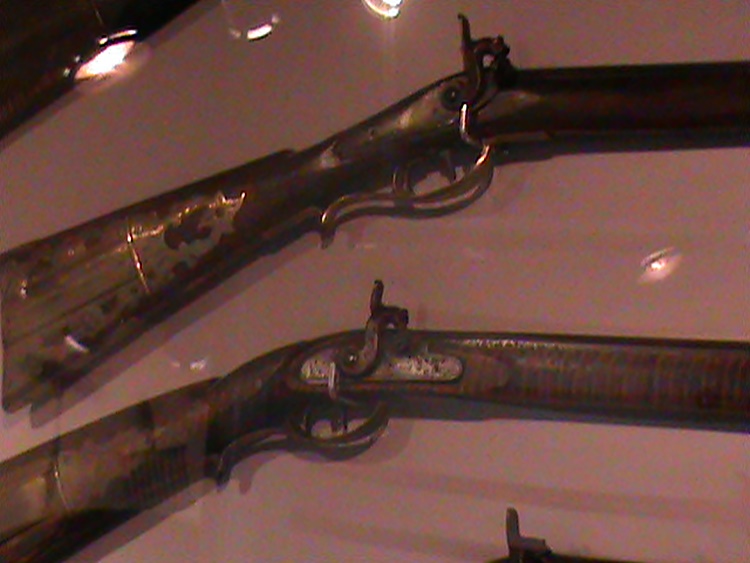
nothing like these exquisite, old rifles, eh?
                                       
                                         
now that is a GUN!


Griffen field gun


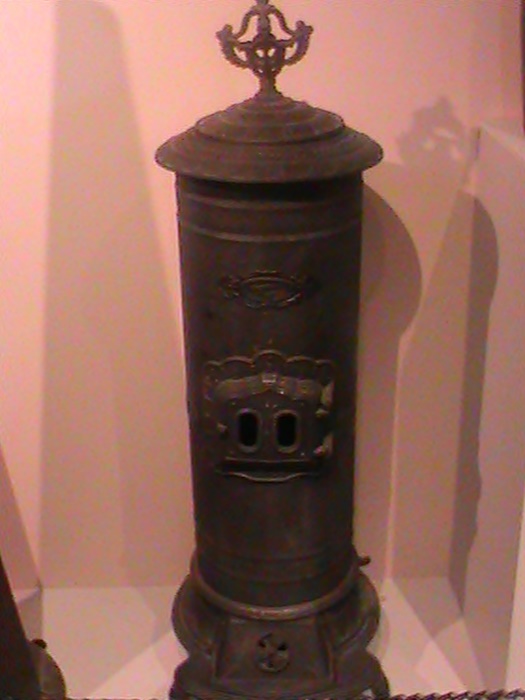
old time stove and heater


    I bought a couple of 'souvenirs' at the gift shop for my growing collection which I'll upload later.

    Before moving on, I want to show the traditional site of Fort Bedford and the reconstruction of the fort itself. At one time, it housed as many as 800 men.


These stones may be what is left of the outer wall

     Following along the Bedford Path southerly of the Raystown Branch of the Juniata River, we quickly arrive at the 'fort' location:

                          
you are...HERE


Ol', new Fort Bedford


Reconstructed fort wall on north side


Fort walkway


     There are many significant sights surrounding this location. Being limited time wise except for a quick stop at the Bedford Tavern, a few photos would have to suffice.

                Some of the preserved houses and buildings:


Old Bedford town


Penn Street
 

A storied building, the Bedford Courthouse

                                        
Oops !
                                         
The SQUARES of William Penn


    Many illustrious and prominent political figures stayed here, especially at the Bedford Springs Hotel, (shown below).

    This includes such famous people as, President James Buchanan, William Henry Harrison, Zachary Taylor, Benjamin Harrison, James Polk and Rutheford B. Hayes. The list could go on. They all came here along the Lincoln Highway back in the 1800's.

                                                      
The modern Bedford Springs Hotel


    My personal feelings about Bedford couldn't be higher. What a wonderful town, brimming with tourists, well kept buildings and stores; a pleasant atmosphere to spend time in.

   One particular site that intrigued me most was the Espy House, at 123 East Pitt St. built in 1766.

   It was named after David Espy, a friend of Washington. 'The Father of our Country' stayed here and kept his headquarters in 1794 during the famous Whiskey Rebellion. The Espy House was also claimed to be General Arthur St. Clair's office when he was active here.

   Provided are a few views over the years:


courtesy of explorehistory.com
                             
Espy House on East Pitt.St.

          
According to tradition, the window George Washington had his private quarters is below:


    Afterward, driving a few miles up Rt. 220, or the cut off of N. Richard St over Rt. 30. and hanging  a left onto Sawblad Rd, I tried to enter Bedford Village and, unfortunately, found it was...CLOSED. A somewhat disappointing experience. Frankly, a bit of a bust:


Bedford Village contains an old Monongahela Indian site


I shall return!


     At least I could check out Claycombe covered bridge:

                           
Claycombe covered bridge


    In the afternoon I took the time to get over to Hoke-E-Geez big flea market down on 145 Bedford Plaza Rd. There's a real variety in their wares. I added a few more items of some historical value along with a few old coins of monetary value too. Nothing that rare, I just get a hankering for a few now and then.Well, the items will probably be enumerated on another post anyway.

   No, the day wasn't near through. Nope. There was more to search out and discover before calling it quits. That's another topical tale...

   Thanks for the patronage! Have you learned something of interest?

   I plan to see you soon for more articles of this ilk. As always, please write to me, and better yet, COMMENT on the blog posts and give your opinions and ideas! You deserve to be heard.


                                    (To Be Continued )    
  

Contact Form

Name

Email *

Message *