Showing posts with label Connellsville. Show all posts

Tuesday, October 27, 2015

Ghosts, Banshees and Witches


 Introduction

  Almost overnight, the leaves turn orange and brown, the air becomes frosty in the harvest moonlight. Is that the wind through the eaves or the old chimney? I know, it is probably just a lonely night owl...maybe. Did you hear what sounds like odd footsteps, or is it the floorboards expanding and contracting in the change of weather?

  
   Here as we are celebrating the ending of the second year of F/WFH, this is the time of the old druid end of the year,  and therefore it is an association in tandem to compare this with November the 1st and how it soon became All Saints Day. Later Christianized by the auspices of the church into 'All Saints Even', the holiday of the dead, known in Ireland as Samhain, influenced later culture so heavily as to bridge the continents with their arcane beliefs. Running the gamut from black cats, turnip or gourd 'jack-o-lanterns', the predecessor of our carved pumpkins, to our trick or treat celebrations. At one time, the last custom was celebrated more by the adults of a community than by the children.


 Is There Proof in the Pudding?

   Without further ado, we will be marking mysterious and vintage reports of the supernatural in various creepy forms. Are these things real, or were they mistaken as factual? Do these events still take place? Am I to be the supreme arbiter between modernism and ancient beliefs? Hardly.  I will only state what should be obvious: the proposed phenomena of paranormal experiences, those that delve deep into theoretical quantum physics dramatically speculating on the subject of higher dimensions with superstring theories, the theological implications of investigations into spiritual realities, may or may not hold water. Yet there are hints of stray evidence that such aspects of reality  co-exist in our world. The polls show our feelings about the supernatural, UFO's, angels, astrology, etc. The acceptance of such depends on your point of view and what you make of it all. This material certainly is interesting in the extreme, that much we do know. Think what you wish, folks.

Halloween Stories


   Whatever the significance of innumerable reams of old, and not so old, stories claimed as true by so many people not too different than you and I, it surely cannot hurt in the retelling, and may be beneficial toward keeping an open mind. Do you concur? If not, or, on the other side of the proverbial coin,you are easily frightened, take a small warning against reading any further. After all, this is that special enchanting time in late October when the silken, slippery veils of nature are sometimes momentarily parted to reveal things wonderful and sometimes, ominous. This creepy old holiday, in some circles still considered a holy day, has been known for many years, far and wide, as Halloween. We let our hair down, have some fun and even imitate for a night those spooks and witches. In truth, the telling of macabre mysteries, whether by firelight at a camp out, or around the porch on a stormy evening, is also an integral branch of our history too. The rarity of the scares might well be the fascination of it.

    Now a days, the lone survivor of the 'burning times' appears to be the fortune tellers and dream books. Back then, the purported pranks of demons and their compatriots was a huge bugaboo of the Middle Ages in which the black arts, which many strongly felt centered in witchcraft and the wicked carnival of dark and malicious mischief of goblins and their ilk, caused the inhabitants to seek after numerous protections, while chasing away the darkness through the unusual customs of their ancestors.

   While we sip a nip of hot cocoa and get comfortable, let's take a moment or two for a proper examination while forming an intoxicating brew of old tales from around our region, beginning and ending with a few well chosen vintage newspaper articles:


   Those Ghosts


       The above article from the Daily Courier is from Feb. 11, 1887.

        Rumors have traditionally surrounded some of the old mines of the region with tales of knocker's, (diminutive mine spirits) and ghosts of those men tragically killed, sometimes victims of 'white damp', smoke inhalation, sudden flames and explosions. This superstitious belief tended to be particularly prominent for the tragic Hill Farm Mine locality of Dunbar, near Pechin Road, once said to of been a home to Indians with its own burial grounds; likewise, the Tyrone Mines in Broadford at Connellsville. An example of such an unfortunate event that tool place all too frequently is given below.


Both mines had experienced local whisperings of this type to the point of affecting the operations wholesale. We won't go into too much detail here, as this information was once more widely known. The same might be stated for the closely associated stories of ghosts and bigfoot of the Dunbar Mountains centering around the Irishtown Road and local legends of the Ghost Rock. The subject was covered last season by the television show, 'Finding Bigfoot'.

                  
The Ghost Rock on Irishtown Road


       Reputedly, the Etna Furnace near the White Rock Distillery was the scene of Connellsville's first murder. Initially, I noticed an observation of its reporting from the year 1904. It is likely the events described are from the 1890's, as this was when the distillery was erected near to the Yough Brewery Company's establishment on S. Arch Street. It was originally called the Gemas Distillery, after the first owner, Mark Gemas. In 1898 it was sold to W. C. Reynolds, and in 1904, it was moved to the old Zachariah Connell homestead on the corner of Arch and Fairview.

      This involved one Wayne Denny, who lived up on the Chestnut Ridge. When he flashed his recent inheritance of gold coins at a nearby tavern, the next morning his broken and bruised body was discovered at the furnace devoid of his precious fortune. The murderers were never found. This was claimed to be a major cause of the haunting of the area where in olden times the vicinity was rife with the talk of scary happenings. Apparently, this was just the start of it all. According to an old historian Frank Pierce, "hogs and cattle seemed to very mysteriously die, their destruction being charged to witchcraft. Great heaps of wood were fixed as if preparing to offer a sacrifice to the gods. On these the dead and strangely sick animals were burned. As the burning progressed, the witch was expected to appear on the scene and sue for peace; for it was claimed by the witch doctor that the burning of the carcasses would also torment and even singe the witch". 

     Strange stuff indeed. One thing is definite, it isn't Yours Truly making any of the material up you're reading here!


       Local talk had circulated quite a few years ago of Iron Bridge being haunted. I, for one, always lent a willing ear to such discussions, however brief. While this is one of many speculative traditions, there are some interesting stories covered on my article HERE which will give you pause as to a few reasons why this claim was made!

        From as recently as June 11, 1960 there was a brief mention of gypsies in The Daily Courier:

    Gypsy lore is very old and hasn't been followed up much. I do know a few from my grandmother's days...         

    In the year of 1909 there was a chilling story making the rounds of the Smithfield ghost related below:


      I do possess other ghost tales from areas much further afield which, for various reasons, mainly concerning the length of this post, I hesitate to go into in any depth here and now.


      To wind things up to an even scarier note, there were old weird things told of Hill Grove Cemetery in Connellsville back in the day, as well as a strange story from Scottdale. The first you may not recall, as this was related 125 years ago.


        Very briefly, the Daily Courier article of October, 1890 goes on to state many later residents felt, since various people died in the old house, that it was allegedly quite haunted. It received nocturnal visits by spirits, in fact, one gentleman, John Mitts, was quoted as saying, "there was something radically wrong with the house." Another dweller said, "the noises heard were wild, weird, and blood-curdling." Ceaseless trampling of feet, an appearance of a dark figure, and children pulled from their beds were the kind of things beyond bumps in the night occurring there over the years. Some said the place was bewitched!


        Then there was once a man named "WITHCRAFT":


       Ghostly tales were afoot in the Fallen Timbers area of New Geneva and New Haven concerning a series of 1883 articles for the Keystone Courier by A. W. Scott, with accounts going as far back as 1814 with stories of Indians and pioneers to boot.


   Old Marmie and his Ghost Hounds


    We have a seemingly formidable old legend centering around the Alliance Furnace, west of Dawson, yet on the borders of Fayette and Westmoreland counties at Jacobs Creek in Lower Tyrone township. This is told of Peter Marmie who once owned the place.

      Historically, the iron furnace began in 1789. Earlier, in 1780, the Pittsburgh firm of Turnbull, Marme and Company patented  the 'Roxbury Tract' of thirty acres at this lonesome spot. It has been said the first bar of iron west of the Allegheny Mountains was made here, and the celebrated Indian fighter, General 'Mad' Anthony Wayne gained his shell and shot here for some of his campaigns. The furnace was little used after 1793 and by 1804 was out of blast for good.


    Supposedly,  when his prospects headed downhill financially he went stark raving mad, ending his last days jumping into the furnace in blast after sending in his prized dogs! Grisly you say? Well, the legend goes that every year on the fateful day at midnight, he can be seen blowing his horn while his ghostly dogs are said to howl at passersby. This is how the old story goes, anyway. Well, it gets better, but just for the telling, not the facts. Sorry to say, the Holker aPapers prove this was Marnie was still  alive after the events recounted. Could this be some mix up of another person, or another furnace? Shades of Odin. Who knows where the mythical spoof originated from.


The Banshee of McClure

Nearing our last story, but by far, not the least by any stretch of the imagination, is one of a more intimate and recent nature. There are witnesses claiming stoutly the actuality of certain eerie happenings that took place in mid-1970's, (and some who only hesitantly will broach the detailed subject). It is what it is. A truly strange tale.

   Those who experience the horror have recounted the facts and I am a party to some of the details. The names are not given, naturally enough, as there are those who simply do not approve of the experience gaining the publicity of a large audience with their names attached to such a thing, and I know this is the case with the next tale. An unpopular reality is retelling this kind of thing to those who probably would not believe it, and who could really blame them?

    Be forewarned, this one is a real hair raising doozie!

    On a summer night about forty years ago, some young campers decided to get together and spend a night at McClure. You must take the road to the left after the turn from Rt. 119, the next turn from the Scottdale exit and go near a hundred yards and to the right. Well, there was just a stand of woods there in those days and now their are only houses. New ones at that. Back then, you could frequent many local areas and no one really cared.

   They had a few beers, listening for a while to some classic rock music and talked til late, totally unaware of the disturbance soon to influence their young, impressionable lives. They brought along and used up a small amount of the firewood gathered for the occasion when a few of them said they felt a bit chilled and others mumbled something about getting the creeps. Another didn't feel too well. SO, the story goes, they rolled out the sleeping bags on entering the tent and prepared for a good night of relaxation and rest. This was hardly to be the case. Just for the exception of one of the quartet.

   You see, only one camper knew the reputation of this place, and since he was a local of McClure, soon he said he suddenly decided to go home and sleep in his own bed. The others chastened him to stay, but no sir, he left down the incline of the small hill toward his house and it's one distant glimmer and was gone, altough his part in this tale is not near over.

  The time was then around 2:00 a. m. and the fellow on the far left side had entered dream land already. That left two who were awake. Soon, almost immediately, a far high pitched sound was heard above the breeze somewhere toward the south. They both commented on it and made statements about how odd it sounded. Was it a woman or a bird? The next thing that happened, maybe a minute later, was a much louder, bolder cry. This time, it came approximately at half the distance and was very unusual to hear, causing serious alarm in their minds. It was distinctly like a cross between a woman and a bird, yet to these guys who well knew the terrain and the animals, trappers, hunters and fisherman, the mystery remained on their ears. As it was clearly neither. "Did you hear that? It is much closer now!" "Yea, I heard it, that is scary. What the hell?" SO they reached for what precious weapons they could locate, a flashlight and a small axe and gripped them tightly deciding when the noise was heard again, to jump out of the tent and confront this unknown menace face to face. What they were not aware of was the fellow that left in a hurry, had heard it all on his way home! He didn't really escape after all.

   The third manifestation arrived. Their hair stood up, or so they thought. The horrible scream was right over the tent they were hunched down in, while the third boy still slept soundly. They carefully described this as excruciatingly loud and ear piercing, as nothing any of them ever heard, before or since. And would ever hope to hear again. The result of this blast of deafening noise which for a few moments had loomed ominously over them, was the two immediately passed out. Asleep. No reaction, no consciousness; that was all.


   This is NOT the end of the story, however.

   The very next day, oddly the memory didn't come to them early, but by bits and pieces. One who had laid there listening in the pitch dark and the fellow who ran home had strange feelings, like someone else was in their heads! Just not themselves, you know. They wandered around for a part of the day and soon pain came creeping up on them. Their necks felt wrenched and would tilt from one side to the other. This happened from the evening until around midnight. The fact is, they both had to be driven to the emergency room and were checked out. The last fellow was told by the doctor, this is a funny coincidence, but a teenager was just in hear complaining of the same exact bone crunching symptoms! Well, pain relievers and a barbiturate were quickly prescribed and they were sent home as best as could be managed. The parents of the kids verified this account. Nothing else could be done. Slowly, the feeling of being hung, and they even said it felt like rope burns on their necks, the slow turning of their heads, excruciatingly agony, from one side and then to the other, slowly but surely subsided. Gradually the pain became a dull ache and eventually went away. By the next day, by all appearances the fellows had, thankfully returned to a normal state. Yet, they both wore crosses from that night on for years to come out of the sheer terror this caused their psyches. This was a well known fact to their close friends and some school mates.

   What the local lad knew and hadn't before told, was that a local woman or lass, was always said by natives of McClure, an old Irish community, to of had a terrible break in her loving relationship with another man. Unfortunately, a child may of been the cause. The sad result of the anguish  she was consumed with started to cause her to lose her mind and in her grief, she killed her newborn baby and hung herself from one of the nearby trees!

   So the old tale went along. One wonders, was this the anniversary of her death? No one could seem to recall, or were not willing to recount any more details in the close net village. Was the banshee there to warn, or take some revenge on any male who came there late at night? It is extremely unlikely the truth will ever be related, but that is the final Halloween tale on our blog post. By the way, invariably, the legend of the banshee uneqiouvically states the creature, for mourning, grief, death, or what not, according to traditional folklore, cries loudly three times. The story is what it is.


    Rain of Reptiles, A Meteor in a Tree, and a Corn Shower

   
     Without a bit of Forteana, (this phrase can be looked up), our supernatural tour might not be complete. Here's an enjoyable one of a rain of reptiles taken from the annals of the Connellsville Daily Courier way back on June 26, 1885. This was is not in the best condition, but I touched it up as best I could. Hopefully when clicked on, it can be read without squinting too much. You do have to see this for yourselves!

       
'    
     (The article is edited into two parts for easier reading at the end)

     How about a shower of corn fodder? Of course, this could be rationally explained by high winds, although the uniqueness of the report from 1939 is worth the telling:


  I seriously doubt anyone old enough to remember is still around.

 The last in this category is a meteor in a tree at Vanderbilt. Yep, this originates from the Altoona Tribune of Aug. 27, 1904. It took a bit of digging to find its location, (pun intended). Check it out:


    There are a few more ghost stories from locals that could be related, one is even of a bigfoot. As most of these are purely second hand, it is to be admitted these type of homegrown stories would be considered that much more questionable. Being that this may be enough for most of you, I will kindly stop here.

                      
pumpkinhead, (sort of)


    Final Word
  
   Here's hoping you found entertainment in this hodgepodge of oddities and ghost stories in this neck of the Pennsylvania woods! On a personal note, I certainly relished searching for these accounts, and presenting them here, on Histbuffer's, Fayette/Westmoreland Forgotten History for the thrill and unusual quality of this post.

   Do you know what I'm thinking, if you do, you're psychic!, How about YOU sending in some of your spookiest experiences or stories? Do you think you can beat these? I would love hear about them!


   I'll leave you to your peace of mind with one last vintage article, this time, a curious old advertisement placed on Friday the 13th on December, 1935 for The Morning Herald. This is for a salve of nose drops:


    Sleep well, after taking time to enjoy the customs of the autumn season after pondering on this weekend of legend and magic. Be safe, be informed, and have yourselves a,

                                HAPPY  HALLOWEEN  !


      The clickable article on the 'reptile rain' in two parts:


Sunday, November 2, 2014

Connellsville Link

   Hello folks. The most recent article was published as of October 31. Since much of the research was in draft form from July, for whatever the reason, Blogger uploaded the article as a July publication instead of one for October.

  IF anyone has difficulty accessing this Post, Read On:

   To make it easier for visitors to the site, I am providing a NEW LINK to the article here, for
Coke, Coal and Colonel Crawford: A Post On Connellsville.

  Thanks for reading and sorry about the technical glitch on Blogger !

Friday, August 1, 2014

Upcoming Posts

    HI ALL,

     I hope you history buffers are having a good summer!


     Rarely do I upload this kind of thing, though a Progress Report might well be due and I'm really in between posts. I figured it might be enlightening to include viewers in the process of what I'm doing, so here's a quick update for upcoming regional and historical articles, starting in a few days.

     Please, read on:


     Firstly, it is rather difficult to believe the website is approaching a year since it's initial inception. I feel it a nice surprise we have seen a steady and healthy growth and this sure means plenty for my expectations. I know, too, there is certainly room for improvement here and there. On that, I could go on and on, (BUT, I won't!). Frankly, this just isn't the type of blog that gets little emotional tidbit entries every couple of days, so I try to incorporate a more factual glut of material and less of the every day side of things on each upload. You probably agree it is, mercifully, absent. Another perception is to be admitted some of the technical areas envisioned in the past are still to be achieved.

     Secondly, I do hope to again get with the Indian artifact collector from Mount Pleasant, Duaine Fuoss, for another and maybe more in depth interview soon. It was also a great experience collaborating on Iron Bridge with the author Lannie Dietle, who helpfully initialized the discussion by sending me information on the area. Something he occasionally does. I feel there has been progress made with more meaningful stuff to pass along as I face challenges through the learning curve.

    I speculated a little foolishly back in February and March  that I may run out of quality ideas for the blog. It could just be the gloom of the cold, cloudy season gave pause for a somewhat hazy period and that can happen to anybody that writes, from time to time. Yet, the feeling was probably related to the first winter I spent without the presence of my parents. We all have to be able to let our cherished loved ones pass on and adjust ourselves to some tragic happenings, and deal with that intense grief, but this was the worst from my side, at least. They meant so much to me and with only a few months separating their deaths, felt devastating. My Dad really meant the world to me. We may of not always seen quite eye to eye, but I respected his war service and many of his religious and practical attitudes. In a world that continually is changing, he was a real man. They both cared for me and my family so much. I was especially close to my Mom too. As I look back, I couldn't say enough about how classy a lady she was and how dutiful and selfless, so deeply concerned with every faucet of my life. As an example, she even traveled a few times with yours truly on trips to Europe and the Bahamas. What vacations those were! So, you can understand the tough situation it was, and is, the adjustment to not having their earthly influence. I do feel they watch, and sometimes guide me from Heaven. Well, as was almost bound to take place sooner or later, somewhere in late spring I became more inspired and had a real brainstorm, (no negative aftereffects, I'm happy to report!), and between doing research and talking to a few distant relatives and acquaintances, it became a prerogative to expand the scope here.

    Of course, if you've been paying attention to recent posts, the Connellsville article is STILL in the computer boardroom, but close to completion. I am also working on the one in front of me which, I'm afraid, may come off to some as a bit of a 'fluff piece' on Latrobe. That is basically finished. It really does have some substantial interest, especially to those of a particular sporting persuasion.

    Eventually, a good coverage concerning World War Two, and possibly other wars and some of the veterans of them would be something to consider. What do YOU think? Let me know if that sounds meaningful enough to many of you for future attention. My Dad spent many years on the railroad before retirement and that is something else that could be used as the nexus of upcoming interest. We'll see.

   The up side to doing your own website is the freedom inherent in making decisions. When to publish and what the subject will contain.

   Yes, you have also probably noted my attempt toward branching out more in the late spring and early summer months, including more information on surrounding townships and counties. Now there are plans to get back to areas closer to home soon, as well, with some good stuff on Everson and West Overton in Upper Tyrone and East Huntington townships, respectively, yet I do enjoy broadening the scope of historical material while gathering more afield in as expansive an erudition as I can manage!

    I also submit articles for a newsletter monthly, (there are those of you that are well aware of that), with limited viewership. Sorry, but it is best to keep it at that level. The main reason to mention this here is the spike in number of hits received on the site are a nice compliment and greatly appreciated. I am in the process of hesitantly and cautiously, doing a few speaking engagements.

   Tackling the important history of Fort Ligonier is a real priority of mine, so that will be coming your way, in time.

    Hopefully, everyone enjoyed the post on the Braddock Crossing at the Yough River Park area. That was an experience that was particularly fun for me too, so it's good the event was covered here with some details on what went on.

    It has been exciting from my stand point to improve my skills as I learn more details about our local history, with a larger knowledge base and meeting like minded people. It is with a wiser dedication to a more efficient mode of writing. in keeping a few articles in the pocket, so to speak, just in case.

    Finally, there's actually much in the early planning stages and, for your sake and mine, this would be unfair to pin myself down to describe anything closer or definite than already stated above. Many concepts haven't been decided on yet, so any explanations that far ahead will have to wait.


     So that's it for now. Keep checking back folks and I'll see you here 'down the road' and 'around the bend' !

     ~ Histbuffer


Sunday, July 6, 2014

The Braddock Road Crossing Reenactment At Connellsville


I hope everyone had a good, patriotic July Fourth!

  On the weekend of June 28 and the 29th, Connellsville held its re-enactment of General Braddock's Crossing festivities of the Yough River here, near Crawford's Cabin. I was glad to be a small part of that.


River Park Crossing area, courtesy of Penn Pilot

   Introduction

   It's doubly interesting, as I have had a post in the works for some time for the city of Connellsville anyway and that's convenient. This was a good opportunity and a meaningful experience all around, one I hadn't had before. The rock and roll music of the Del Sols was nice, they could actually play! Whiling away some time, many of the families tended to gather at booths, displays and the Balsley Pavilion, built in 2011, to beat the heat a little and enjoy some fun. This is as about as soon as this article could be done, since we are so close on the heels of July Fourth celebrations. I would like to add that The Greater Connellsville Chamber will sponsor the main fireworks there.

   Some Broader History

   In brief, during the Seven Years War of Europe, some of which played out here in what became our own unique backyard, so was being 'invaded' by the French, generous to the natives, but with long supply lines from Canada, while attempting control of the waterways and fur trade, goaded by the old claims of explorers LaSalle and Celeron.  While Pennsylvania was naturally inhabited more toward the east by the British, (and Germans, Dutch and Swiss), of the 13 royal colonies of the King of England since the 1600's, by grant of 'Penn's Woods', they were pushing westward for the prospect of more less expensive land. Once, southwestern PA was originally inhabited by the Monongehela and Woodland Cultures, and later, Algonquin, Susquehannock or Conestoga, and then some of the Iroquois from the more northern regions. And though the Seneca were the most powerful on the western corridor, first in rank were the Mohawk and the Onondagas; the Leni Lenape, and sub clans, which held the Munsees; and the Kanhawhas. As well, the nearby areas were visited on the periphery at times by other tribes and sub tribes passing through, such were the Shawnee, Wyandot and Nanticokes, with mixed clans of varying allegiences and agendas, such as the Mingos. As things stood, the provincial situation here in the Ohio Valley west of the Alleghenies was becoming a crucial hotbed and violence and bloodshed was honing in on the surrounding pioneers.

  Now that we have laid some groundwork for the urgency of the route taken and this crossing of the Youghiogheny River, I will leave off to relate the recent adventure of a tamer nature to this very place. (some research gained from 'The Indian Wars of Pennsylvania', C. Hale Sipe).


    My Lone Route

   So, down I went by Route 119, heading to the car park and turning right after a very mild crossing of my own on the Memorial Bridge on the west side of the city. Having  camera in hand, and some beef jerky, with the temperatures hovering in the mid 80's, and in need of a cold drink, I had my eye out for a parking spot. The forecast predicted foreboding thunderstorms and I wondered what treatment that weather would receive by the powers that be, centered around something to do with splashing through a river of water with lightening all around!

                                           The Festival

Yough River Park
    At the Yough River Park area, they had a nice Art on the Yough show, which I didn't really have time to take in. About 12 p.m. the Historical Society began speaking, (and speaking...), and thus began the ceremonials preliminary to the actual crossing itself at 1 o'clock.


A very exciting take on the colorful fording here, I might add! It gets the kids out of the history book mode, away from the video games and bringing to life a pretty fair impression of the reality behind the festival. It may of been marred ever so slightly by so many of the 'rent-a-cops', (no disrespect), and the presence of numerous firemen in the river.


   Add to that, the very long bright yellow rope the whole way across, well it does lose something in the translation. I looked longingly, but failed to find Mr. Braddock or his horse.


   Here you can also see the rafters interfering a bit on their journey down river.

Don't shoot, we're not French!


   But, with the shouting, band playing, splashing and shooting, hot damn, this felt right up my alley. All in all, it was enjoyable, especially the puzzling continual shooting of the muskets by the interestingly attired colonial re-enactors.


musket fire at Braddock's Crossing


Keep that flag held high!

    I'm not sure who was who exactly, but you would suppose this might of been a needed consideration for extra drama; and it does get your attention.


the British are coming


some good reenactors at the festival posing for a photo


       The recreation of Col. Crawford's 1766 cabin:

recreation of Colonel Crawford's Cabin


Crawford at the Carnegie Library

                                  Historical Background

   For the nitty-gritty, historically speaking, linking up to the Greater Allegheny Passage, locally, you can follow the Heritage Trail signs on the west side around a two mile area and ride or walk to take in the sights. The British themselves, were busy following the Nemacolin Indian path and part of the Catawba Trail; the exciting tale of the breaking and forging of Braddock's Road up a mostly, northwesterly route, through Fayette and Westmoreland during the heat of the French and Indian War, in 1755. This truly historic route would become the National Pike, then the future Route 40 and U. S. 68.

   Briefly, one Major General Edward Braddock, (1695- 1755), of the Coldstream Guards:


Major General Edward Braddock, courtesy, Wiki Commons

   He was responsible for launching the Expedition to defeat the French and Indians, (including Seneca, Mingo, Shawnee and some Delaware tribes), and with 21 year old George Washington, recently of Fort Necessity who had scouted the region well for Virginia previously with Christopher Gist, now as aide de camp and a Major, and, at least, part of the way, a young wagoner named Daniel Boone, Colonel Thomas Gage, Captain Horatio Gates, future commander of the continental forces and Indian guides, on the long march to the forks of the Ohio, with roughly, 2,600 troops, baggage, wagons and artillery, was assigned to the colonies for the taking of Fort Duquesne. Widening the road as they moved along, Colonel Dunbar was assigned the control of the artillery and some of the heavier supplies on Chestnut Ridge.

   This led to the fateful encounter in July and surprising ambush at the three hour Battle of the Monongehela, with approaching 900 casualties, the Major General severely and mortally wounded and the hasty, disorganized retreat; Braddock's burial by Colonel George Washington, and quick journey back to Will's Creek, Maryland. Much else can be said of the cutting of the wider road, the unfortunate tactics at the Field of his name, Dunbar's over reaction to the oncoming danger posed by the French, etc. We are here to concentrate our attention to the after affects of the following of Stewart's earlier Crossing here near Colonel Crawford's historic cabin in what was said to be three feet of water at the Yough Park, an area full of historical significance, at the 2014 June Festival at Connellsville, Fayette County, separated in time, hundreds of years later.


The route was also used as part of the Underground Railroad, to help escaping slaves in the 1800's and today is a good place with swimming, biking, hiking and fishing.

   Coming from the area of Mt. Braddock on Laurel Ridge, past Gist's Plantation, and Robinson's Falls at New Haven where the army camped and before the next camp at the Narrows, a mile towards the north, you come to Stewart's Crossing on the Youghiogheny River. More information here. Information on Mt. Braddock and Gist here.


    William Stewart was an early settler on the western side of the Yough River, near Opossum Run and Mount's Creek in what became Connellsville in 1753.

    A tragedy of a different sort involve a Scots-Irishman, Colonel William Crawford, 1732-1782, an early surveyor and soldier with connections to Washington and his Virginia Regiment. Tortured by the Indians and tragically burned at the stake in Sandusky, Ohio. He also fought in the Revolutionary War.


fireplace in Crawford's cabin
    This is done in honor of the work of a man and an army of what were then British soldiers in colonial days of yore. Washington had said of him later, in retrospect, "Thus died a man, whose good and bad qualities were intimately blended. He was brave even to a fault and in regular Service would have done honor to his profession. His attachments were warm, his enmities were strong, and having no disguise about him, both appeared in full force."


     It was a great learning experience for the young and old. We are seriously indebted to the Connellsville borough, Historical Society and the Fayette County Cultural Trust for holding the meaningful and cultural event there, as well as all the other sponsors.

    Any of you that were here this weekend, please go ahead, be proud and leave a comment with a little of what you thought of the event and what all you did.

    Here's some more of the action:

best I could do as it was a bit crowded


Indian hut with Colonial and Indian weapons

.
Native American at the Yough

Not Robin Hood and Little John here!

old days of Pennsylvania fire power

seller of Indian artifacts and Native American goods (I bought some)

animal pelts for the rendezvous

ready for the Narrow's encampment ?

C'mon, hurry back for the BBQ, boys!


   The Connellsville post will be up sometime soon, just don't get impatient. And in the mean time, I do have a few other plans in the pipeline. So, stay tuned and check back!
    - Histbuffer

Coal, Coke and Colonel Crawford: A Post On Connellsville


Some Historical Reflections of Connellsville


 Introduction


    I meant for some time to get to this important city of Fayette County, but one item or another kept me from giving it all my attention and resources. So, I got out my camera and a few maps and delved deeper into the subject.

   This post is about the unique history of Connellsville, once a large borough north of Uniontown, the county seat. It was incorporated in 1806, in Fayette County Pennsylvania and in 1906 became a city. It is beyond our scope to attempt a significant rundown from A-Z, so a patchwork of the region will have to suffice. Any locals that would like to add something interesting, please help to fill in the blanks.

   [NOTE: The borough of South Connellsville will be a subject for future coverage]

Very Early Days


   The city that joined with New Haven about 1917 is as interesting in details as it can be captivating in it's depth.  Lying near the heart of what is termed the Connellsville Coalfield, the borough is partly circled on the west by the Youghiogheny River, an important resource that called people to the area and to where many started settling in the late 1770's. This included the French from the north as well who claimed this land and the Delaware, Shawnee and Kanhawas and other tribes of Indians who were here even earlier. The coal strike labor dispute situation in 1891, led to some serious violence.

    The timber was a real attraction, especially the oak trees and, of course, the coal and ore production. The coal was baked to harden into coke, thereby used to smelt the iron ore. This was the custom all around the area.

                                   
courtesy, Library of Congress

   The fur trade was very popular too. The Catawba Indian Trail crossed through the region and the Ohio Company were heavily involved in exploring as they also hunted and trapped. Christopher Gist had major involvement as a surveyor from Virginia and then as a resident. He was a confidante, guide and friend of a young George Washington, who himself a surveyor, passed through here by way of Stewart's Crossings at different times, on his way to Le Beouf and later, Fort Duquesne experiencing much of the regional places and customs leading up to the  French and Indian War.

   Here's an historical marker for Jumonville:


courtesy of explorehistory.com
     And here's an historical marker for Braddock's Twelfth Camp here: (and two markers are better than one!)

explorehistory.com
                    
                                         
   General Braddock's march led through his army through here and forded the Yough River at Stewart's Crossing. There, will be found Colonel Crawford's Cabin, though reconstructed, and the remnant of road named for his efforts, especially Washington's, which ended in a tragic defeat, only rectified by the Forbes Expedition and Bouquet's route clearing of the Glade Pike. You will find more on this fascinating event of historical import on the post about the Yough River Park reenactment I attended in late June and I also invite you to check out my post on a route traversed in Upper Tyrone of The Lost Cemetery and Braddock Road. There is a more recent investigation related to the Braddock Road and Turkey Foot Road remnants near the Walnut Hill area. This will help give much extra information and allow for a better overview of this historical subject.

   Washington made his way here again toward Fort Le Boeuf, near Erie PA, to meet and discuss the encroachment of the French beforehand. Gist eventually came to dwell at Mount Braddock. The dastardly, dashing French of the time managed to destroy most, if not all, of his settlement. There is also much quality info from the Korns.org site in a pdf. file right HERE.

  George Washington also met the Half King Seneca Indian leader Tanacharisson close by at Jumonville where he also helped fight the French 'scouting party' at Jumonville Glen near Dunbr's Knob and caused some serious diplomatic troubles with the lifting of scalps. As is well known, thus began the French and Indian War with the famous 'shot heard round the world.' The rest is our history, folks.

  It should be noted that Providence Mounts of Bullskin lived near Connellsville at White's bridge, (the run was named after Henry White), on Whites Run. According to 'The History Of Fayette County", by Franklin Ellis, page 486, "At the mouth of White's Run, and partially in the present township of Connellsville, was the tract of land owned by Providence Mounts." He goes on to say, " Providence Mounts was probably the earliest of these settlers, and the principal stream of the township took its name from him. Just below the Bullskin line. Mounts had a mill at a very early day, and wool-carding was carried on at the same place." he was also involved with clearing the old Turkey Foot Road and was a Sheriff of Westmoreland County. More on that at another time.

   Speaking earlier of Indians in the area, (were we? well, we are now!), a friend I recently collaborated with, quoted something for me: 'the 1906 Borough of Connellsville' mentions: Indian village (surely burial close by), by Yough River between Adleaide Rd and Georgetown Manor area: Oglevee Lane, top of where Braddock Road intersects'. Well, I appreciate the reference being pointed out to me. Isn't that interesting now? I plan a future post on the Indian villages in our region and a map schematic for this eventually. There is more to be looked into from the hard to find book, "The Other Side Of History" on the subject of Indians in our region, and I will look into including this shortly.

    The city was indeed influenced heavily by the Whiskey Rebellion of 1794 as the tax was felt strongly here as well as other counties, towns and villages. One officer, Benjamin Wells, was even driven out and his home burned, which would of made quite a statement by the upset farmers and angry distillers. The uprising was soon put down by, none other, than George Washington and his Army of the new Republic of the United States.

    Colonel William Crawford's figure stands majestically, and yet somewhat tragically, in front to the Carnegie Free Public Library, built over an old cemetery in 1901, partly with funds from the tycoon Andrew Carnegie. He was captured, tortured and burned at the stake on the Sandusky  expedition in Ohio. I decided against recounting his suffering in detail, except that his bravery was said to be nothing less than amazing and inspiring during this tortuous ordeal.  Crawford came from what was Frederick County, Virginia, being born in 1732, that from 'History of Fayette County, Penn.', 1882, Franklin Ellis. He had moved to near Stewart's Crossing on the Youghiogheny by 1765, convinced by the state government that this was a part of Virginia. Washington was suppose to of stayed at his home around 1770, which seems very likely, as he was a fellow surveyor and lieutenant under Washington by 1758. He was also a half-brother to the Stephensons. ('Forbes Expedition', 1941), and commissioned a Colonel of the 7th Virginia Regiment by 1777.

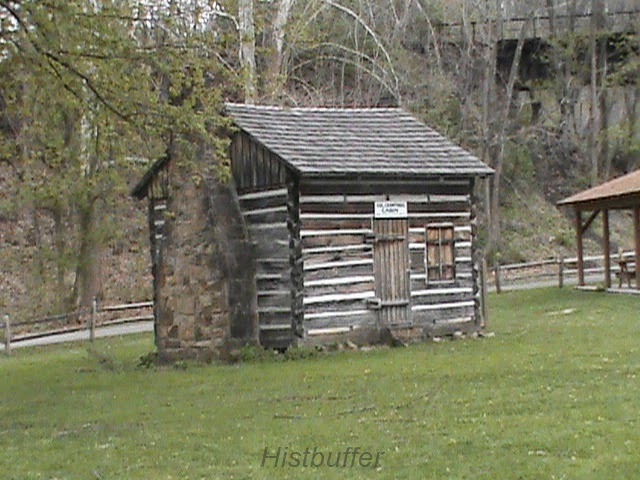
Colonel Crawford's reconstructed cabin at Yough River Park


   He was in many of the campaigns, (at least six), of the Revolutionary War. He also served at Fort Pitt in the late 1770's and was on Forbes' successful march. His life ended very tragically in Sandusky in 1782, at the hands of the Shawnee Indians, (Washington-Crawford Letters). Some 'Blue', (or 'Black'), Mingos also, which were mostly a blend of Seneca and Cayugas. There is the Colonel Crawford Burn Site Monument in Wyandot County in Ohio commemorating his death in 1782 on the Sandusky River where he led Pennsylvanians in reprisal to destroy Indian villages in the Crawford Expedition. His re-created cabin resides at the Yough River Park, along with the spring house. This was also where William Stewart, an early settler, made his crossing and Major General Braddock took the army through the west side of Connellsville during the famed French and Indian War. This place exudes history like an aromatic calendar! The Community held the historic Braddock's Crossing festival and 'Art on the Yough' show at the end of June and I made it there as well. More information on that event is added at the link above and more material on Stewart will be upcoming.

    Crawford's Memorial statue and plaque can be easily observe in front of the Carnegie Library, 1260 yards from where, in 1765 he had his cabin. He is listed as pioneer, patriot, but first of all, 'friend of Washington'.

 As an afterthought, I suppose it interesting and a bit ironic, that the Old Connell grave yard was the site of the new Library. So at this time of year, maybe it is fitting to relate there are the reports of hauntings in the quiet realm of microfilm and newspapers! Thus, when removing the bodies to Chestnut Hill, according to the Fayette County Cultural Trust, this caused much dissension in the community and was thought of as a a ghoulish undertaking.

                                        Old Lore

    Out from old books come some surprising, even titillating tidbits, gems and stories, often without much in the way of source material to go on. Yet, there can be substance behind the traditional tales, especially as it is known the Indians were certainly in this area. The Connellsville Historical Society may well be able to help fill in the blanks with some meaningful knowledge on the subject, so give them a try.

    There is information that a particular, though apparently, unmentioned, tribe of Indians had their village located about 5 miles east of Connellsville. 'Here' was an extensive burial ground where it is, or was, believed by tradition in these parts ' that one thousand red men slept'. So saying, another, and smaller village was located on the banks of the Youghiogheny River, as the crow flies, about two miles above the mouth of Bear Run. 'In both of these places a large number of flints have been found'.

   As stated above, I will have a separate post on Native American artifacts and burial grounds 'down the road' some day. So, just when some doubter, (oh those of little faith!), thinks it unlikely for the appearance on the blog of something I promised, then, surprise, this is probably the time when I will deliver.

  Now that we have that straightened out, it is also believed there were some bold French traders from the Canada's settled in Fayette County as early as early as 1730. We do know, then the French built their forts in this 'section' and, technically, one George Washington was sent to warn them away, unsuccessfully, as they were on 'English lands'. This proved totally ineffective. On the trip out he spent a few days at the home of Mr., (Christopher), Gist at Mt. Braddock, a house technically still standing and refurbished. Gist had accompanied him as it has been claimed, as did William Crawford at times.Both were on the highly potent Forbes Expedition.This was wild country, with bears, buffaloes, cougars, elk and even wolves in the deep forests, as Thomas Hutchins made some mention of in 1764. He was in Bouquet's Expedition and was actually bragging up the area.
   

  South  C' Ville

    As stated above, this area will be dealt with at another time. For those of you that live there, I won't forget to give your area special coverage, thanks.

   Anchor Hocking


  The 'Capstan Glass Company' of South Connellsville has quite a history. With hindsight, some of it is sad, and even tragic. This will all be covered in more detail soon.

   Now back to the meat and potatoes of local Connellsville history:

     Stewart and Connell


    William Stewart and his brothers were pioneers that settled here near to the early 1750's, soon using the flatboats being made to ferry people across the Youghiogheny River. This was traditionally on the eastern embankment at Stewart's Crossings, very aptly named. This area was used later for barging materials down to the Monongehela River and on to the Ohio and places like the Mississippi Delta region and Louisiana. A house built by him in 1753 was burned by the French, (as was Gist's plantation at Mt. Braddock), after the British had the failed encounter at Fort Necessity and  this drove him from the place of his new home by 1754.


    Zachariah Connell, 1741-1813, the tee-totaling son of James Connell, was an early and powerful settler to the region, was the generous benefactor from whom the city received its name, arriving here near the time of Washington and boarding for a while with Colonel Crawford I've said so much about. The man himself, the very structure of this city rested its laurels upon, hailed from Frederick,Virginia. At times he was found involved with land speculation quite early on, in what was then the older township of Bullskin. He was married to one Rebecca Rice and by, approximately 1770, he founded the nucleus of the borough named after him in 1806.

   He was a prominent judge and as stated above, a hearty Virginian of the jurisdiction of the West Augusta District of Youghioghania County of which this whole area was mistakenly thought to be part and parcel of, contrary to the strong views of the Penns'. Connell, a captain of the militia, was very influential with the Governor there, (not of Pennsylvania), Robert Dinwiddie, that history sometimes views, with reason, with Dr. John Connolly in the number one position, as quite a troublemaker. He also served under William Perry in the War for Independence.

   Connell had surveyed for himself a large tract of land called 'Mud Island' at the time and basically began the plot of the town beginning in 1793. He died at his Water Street home and is buried nearby. His wife Margaret passed on in 1845. His marker is about 100 feet below his grave site in the woods on East Francis Ave.

   Zacharia Connell was closely connected to William Crawford in fact, supposedly through Ann Crawford, he was his father-in-law. His second wife Margaret Wallace's sister, Jennifer, was at one time the keeper of the tolls at the river, according to Historic PA dot net.. He did his best to influence the Pennsylvania General Assembly at Philadelphia on the 21 of February in 1786.It is debatable what was the exact result of his official inquiry, but to quote the old pamphlet and newspaper article of the words of the Vice President of the Supreme Executive Council, Charles Biddle,

    "A petition of Zachariah Connell was read, praying leave to bring in a bill, for the purpose of authorizing him, his heirs and assigns, to establish and maintain a ferry over the river Yoghiogeny, in Bullskin township, in the county of Fayette", with the hardly reassuring sentence following at the end, "Ordered to lie on the table."

    A lot of local products were shipped to the Monongahela by way of the 'Yough' and on to the Ohio and Pittsburgh areas. 

     It was said that Zach owned over 2,500 acres in the area that is now Connellsville, though he lived in fairly humble circumstances. Under his tutelage the town was laid out at 45 acres and he granted the inhabitants many privileges. The charter bore the date March 21, 1793.

    Many of those that arrived here came by the Allegheny Passage southwest or the old Turkey Foot Road from the southeast from Maryland.

Contact Form

Name

Email *

Message *